Four Conditions for Cultivating Cultures That People Don't Have to Recover From

Every year, organisations lose talented people, millions of working days and untold momentum — not because their staff cannot do the work, but because the culture slowly wears them down, or forces them out. When performance suffers, the reflex is to blame the individual and recruit a replacement, as if the culture were the one thing that could not possibly be the problem. This article challenges that assumption. It argues that a culture is not something you control by removing the people who struggle in it, but something you grow — and it sets out the four conditions every culture either builds or breaks, a simple diagnostic for spotting the warning signs, and ten practical ways for leaders to build a workplace people can thrive in rather than recover from.

A Crisis Hiding in Plain Sight
The numbers are difficult to ignore. In 2024/25, 964,000 workers in Great Britain suffered from work-related stress, depression or anxiety, according to the Health and Safety Executive — close to a million people, resulting in an estimated 22.1 million working days lost. Stress, depression and anxiety now account for around half of all work-related ill health. UK sickness absence has climbed to an average of 7.8 days per employee, the highest the CIPD has recorded in over a decade and up from 5.8 days before the pandemic, with more than three-quarters of organisations reporting stress-related absence.
The financial scale is just as stark. Deloitte puts the cost of poor mental health to UK employers at £51 billion a year — and the single largest component is not people being off sick, but presenteeism, people at their desks yet unable to perform, at around £24 billion. Globally, Gallup estimates that low engagement drains $8.8 trillion from the world economy, equivalent to 9% of global GDP, while only 23% of employees are engaged at work.
The problem is not spread evenly. Sickness absence in the public sector runs consistently higher than in the private — 2.9% against 1.8% in 2024, and higher in every year on record — and presenteeism tends to track the same divide. That should stop leaders in their tracks, because it upends a comfortable assumption. Public service is where meaning and purpose are most explicit: people go into healthcare, education, local government and the emergency services precisely because the work matters. If a strong sense of purpose were enough to sustain people, these would be the healthiest cultures in the country. Instead they are among the most strained. It is a live demonstration of the argument at the heart of this piece — that one condition on its own, even one as powerful as purpose, cannot hold a culture up. Where people have meaning but little agency, thin support and relentless demand, purpose does not protect them; it keeps them clinging on until they burn out.
The most important finding in all of this research is the easiest to miss. Gallup is unambiguous that engagement is not a personality trait employees either have or lack — it is, in their words, “an experience created by organisations, managers and team members.” In other words, disengagement, attrition and absence are not, at root, people problems. They are conditions problems. And conditions are built.
Recovery is a response to harm
I have built a business helping people recover from their working lives. Redundancy, burnout, the slow erosion of confidence that happens when a role stops fitting the person in it — this is the work that fills my week. And the longer I do it, the more one uncomfortable question keeps surfacing: what if so many people never needed recovering in the first place?
We have quietly normalised the idea that work depletes people, and that it is the individual’s job to repair the damage on their own time — through a wellbeing app, a resilience workshop, a weekend that is never quite long enough. But recovery is, by definition, a response to harm. You do not recover from something that did not hurt you. So if your people are routinely recovering from their culture, the culture is the thing to look at.
You Cannot Recruit Your Way Out of Your Own Culture
When performance dips or people start to struggle, the reflex in many organisations is to look hard at the person. Someone is not resilient enough, not committed enough, not quite the right fit. So they are managed, put on a plan, or quietly encouraged towards the door — and a replacement is recruited in the hope that fresh blood will change things. Eighteen months later the new recruit is showing exactly the same signs of strain, and the cycle begins again.
This is one of the most expensive mistakes a leadership team can make, because it treats a conditions problem as a people problem. If four capable people have burned out in the same role, the likeliest explanation is not that you keep hiring the wrong people. It is that the role, the team or the culture around it is doing the damage — and you are paying, over and over, to replace the evidence rather than fix the cause.
There is a revealing clue buried in the language itself. Too many organisations treat their people like bacteria in a lab — something to be monitored, contained, and, when inconvenient, sterilised out and replaced. But a culture, by its very definition, is not something you control. It is something you grow. The word shares its root with cultivation. You do not build a thriving culture by removing the people who wilt in poor conditions; you build it by creating the conditions in which people can flourish — nurturing, developing and stretching them, rather than policing and replacing them.
The same lesson runs through nature. A monoculture — a single crop, a single strain, engineered for uniformity — looks efficient and easy to control, right up until one disease or one hard season wipes it out. What makes a natural system resilient is variety: it is the diversity of species, and of traits within them, that lets an ecosystem absorb shocks, adapt and keep growing. Organisations are no different. When leaders recruit in their own image, prize “fit” above all, and quietly move on anyone who does not conform, they are cultivating a monoculture — comfortable, uniform and dangerously fragile. It is the range of perspectives, experiences and ways of thinking in a team that produces better decisions, catches more risks and generates the creative friction from which real innovation comes. Variety breeds strength. Sameness, however tidy, breeds fragility.
That shift — from controlling people to cultivating conditions — is the heart of this argument. Because the culture is the one thing that stays behind when the people leave. Change the people but not the conditions, and you have changed nothing. Grow the conditions, and you rarely need to change the people at all.
The Four Conditions Every Culture Builds or Breaks
In my coaching work I see the same collapse again and again when a career ends abruptly. It is never really the job people grieve. It is four things the job quietly provided: a sense of agency, a sense of competence, a sense of belonging, and a sense of coherence — the feeling that what they do matters and adds up to something greater than them. When those four conditions go, purpose goes with them. I tell clients: you haven’t lost your purpose, you’ve lost the conditions for it.
Here is the part that should interest every leader. Those same four conditions are the ones a culture builds or destroys every single day — long before anyone reaches the point of needing to recover.
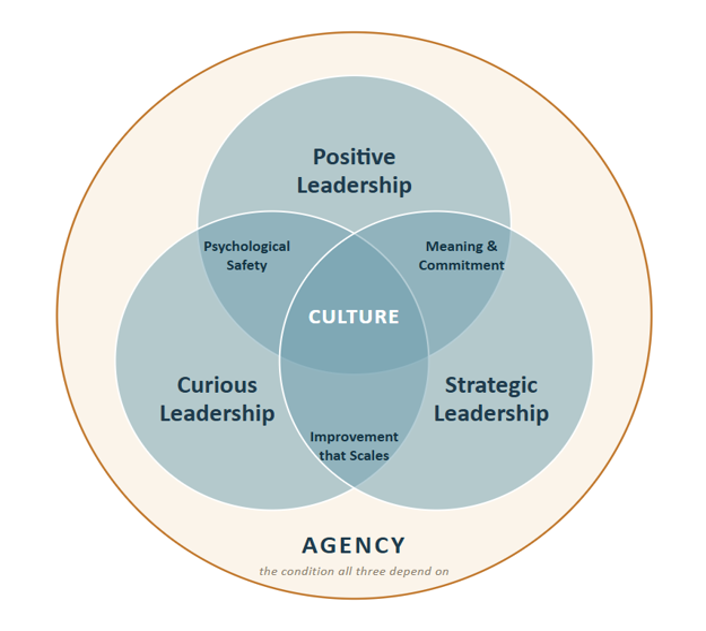
But the four are not equal partners. One of them — agency — is the backbone: the condition the other three depend on. People who feel they have no control and no voice rarely invest in growing their competence, building relationships or committing to a shared direction. It is where any honest attempt to change a culture has to begin.
Agency is the sense of having some control over how you work, and a voice that is genuinely heard. It is the backbone of the whole model — the condition the other three rest on — because people who feel powerless rarely invest in anything else. Cultures that micromanage, punish honesty or treat questions as insubordination strip it away, and the cost is silence, because problems stay hidden until they become expensive. Restoring agency is the heart of what I call curious leadership, and it is where the work of building a high-functioning culture begins.
Competence is the need to exercise your strengths and demonstrate your capabilities. We all need to feel we’re good at something and to keep growing. Cultures that offer no development, stretch or feedback leave capable people feeling stuck, demotivated and quietly looking elsewhere. Competence is not an asset you hire once; it is a condition you nurture, and it is the cheapest form of retention there is.
Belonging — relatedness — is the sense of being connected to colleagues and to a shared endeavour. Isolation is one of the most common things I hear from clients, and it does not begin the day someone leaves; it builds inside teams where people feel unseen. Belonging is what positive leadership creates, and it is a performance variable, not a perk.
Coherence is the sense that the work has meaning and points somewhere. Constant restructures, contradictory priorities and strategy no one can explain erode it, and with it the reason to stay engaged. Coherence is the work of strategic leadership: giving people a story about where the organisation is going that they can place themselves inside.
What You’ll Be Seeing: A Culture Diagnostic
You do not need a staff survey to know whether these four conditions are healthy. They show up in everyday behaviour. Use the grid below as a quick diagnostic: for each condition, which column sounds more like an ordinary week in your organisation?
| Condition | What you’ll see when it’s eroding | What you’ll see when it’s strong |
| Agency | Decisions land without consultation · people wait to be told · concerns go unspoken · “we’ve always done it this way” · quiet compliance and presenteeism | People take initiative and own their work · questions and challenge are routine · problems surface early · discretionary effort is high |
| Competence | No time or budget to develop · capable people plateau · gaps filled by recruiting, not growing · talent leaves for “a step up” elsewhere | Clear growth paths and regular feedback · people are stretched, not stranded · internal promotion is normal · learning is part of the job |
| Belonging | Silos and cliques · people feel unseen · low trust · isolation, especially in hybrid teams · “us and them” between staff and leadership | Strong peer relationships · people ask for and offer help · new joiners integrate fast · a genuine, shared sense of “we” |
| Coherence | Constant reorganisation · shifting or contradictory priorities · strategy no one can explain · work that feels pointless · change fatigue | People connect their work to a clear purpose · priorities are stable and understood · change is explained and paced · a credible direction |
If most of your honest answers sit in the left-hand column, you do not have a wellbeing problem to solve with an app. You have a culture that people are having to recover from — and that is a leadership question.
I Have Seen It From Both Sides
I do not write this only as a coach. I have been made redundant three times, so I know from the inside what it is to lose the conditions a role provided and to be expected to simply get on with it. And earlier in my career, as a charity chief executive and a senior leader in the public sector, I saw the same thing from the other side of the desk — watching capable, committed people slowly worn down by cultures that eroded their agency, their sense of belonging and their belief that the work meant something. I have watched people hold on to a role for the meaning in it long after the other conditions had crumbled — and burn out anyway, because meaning on its own was never going to be enough.
What I learned from both vantage points is the same: almost no one sets out to build a culture people have to recover from. It happens by default — through good people under pressure, making a series of small, understandable decisions that quietly strip the four conditions away. Which is the hopeful part. What is built by default can be built on purpose instead.
From Harm Reduction to High Performance
It would be easy to read all of this as damage limitation. It is far more than that. The very conditions that stop people needing to recover are the conditions that produce the outcomes boards actually want.
When people have agency and feel safe to speak, you get innovation. Psychological safety — the belief that you can ask a question, admit a mistake or challenge an idea without fear of embarrassment or reprisal — is consistently found to be the strongest predictor of team performance, most famously in Google’s own research into what makes its best teams work. Ideas surface earlier, mistakes are caught sooner, and improvement becomes continuous rather than occasional.
But safety on its own is not enough. Innovation comes from difference — from people who see the same problem from genuinely different angles — and difference is only an asset when people feel safe enough to voice it. A diverse team without psychological safety simply keeps its best ideas to itself; a safe team without diversity is only ever comfortable. You need both: a real range of perspectives, and a culture in which the outlying view is welcomed rather than quietly smoothed away. That combination is precisely where the ideas your competitors do not have come from.
When people are engaged, the commercial gap is stark. Gallup’s most engaged teams are 23% more profitable than their least engaged counterparts and hold on to their people far more successfully. And the return is measurable: Deloitte finds employers get back an average of £4.70 for every £1 they invest in their people’s mental health and wellbeing. A culture people do not have to recover from is not a cost centre. It is one of the highest-return investments a leadership team can make.
Ten Ways to Build a Culture People Don’t Have to Recover From
1. Audit the ordinary day, not the away-day. Culture is not your values poster or your annual conference. It is what an average Tuesday feels like. Start by asking honestly what your ordinary week does to the four conditions — because that is what your people actually live.
2. Ask before you assume. Agency grows when people have a genuine say in how their work is done so they can exercise their unique character strengths. Build real consultation (co-production) into decisions that affect them, and act visibly on what you hear — otherwise “consultation” swiftly erodes trust even faster than silence.
3. Make it safe to speak — and to disagree. Reward the person who raises the problem, not just the one who solves it, and treat the dissenting or unusual view (the black hats and the laggards) as a gift rather than a nuisance. If honesty is punished and difference is smoothed away or ignored, you will be the last to know when something is wrong — and you will forfeit the ideas that only ever come from people who see it differently.
4. Treat development as retention, not reward. Capable people leave when they stop growing. Development is not a perk you offer your best performers; it is the maintenance cost of keeping competence — and curious people — in the building.
5. Design for belonging — but not for sameness. Connection rarely happens by accident, least of all in hybrid teams, so build in the moments that let people feel seen and supported. But remember that belonging is not uniformity: recruiting for “fit” and rewarding conformity breeds a fragile monoculture. The goal is a team where people who think differently are embraced so everyone feels they belong.
6. Explain the why — and keep explaining it. Coherence collapses when people cannot connect their work to a purpose or greater goal or vision. Repeat the story of where the organisation is going far more often than feels necessary; what is obvious to you at the top is rarely obvious three layers down or on the coalface.
7. Protect people from constant change. Endless reorganisation is one of the fastest ways to erode coherence, exhaust goodwill and destroy trust. Be honest about your motives, sequence and pace change, finish what you start, and be clear about what is not changing.
8. Remember that managers are the culture. Most people do not experience “the organisation” — they experience their line manager. Invest in developing your managers (anyone responsible for leading others) as the people who build or break the four conditions every day, because they are the ones who do.
9. Measure the leading indicators, not just the exit interview. By the time someone resigns, the damage is done. Track the early signals in the diagnostic above — falling initiative, rising silence, creeping isolation, working to rule — so you can act while it still costs you nothing.
10. Model it from the top. A leader who never switches off, never admits a mistake and never asks for help teaches everyone else to do the same. The four conditions are built, or broken, by example first.
Start With One Honest Question
So, the question I would put to any leadership team is not “how good is our wellbeing offer?” It is something far more searching: what is it actually like to work here on an ordinary Tuesday — and what is that ordinary day doing to the four conditions your people need in order to flourish?
Building a culture people do not have to recover from is not about doing more. It is about doing less harm and building the right conditions on purpose — agency, competence, belonging and coherence — so that performance, innovation and growth follow as consequences rather than being chased as targets. And you cannot recruit your way to a better culture — you can only grow one, in the people you already have. Purpose, in people and in organisations alike, is not found. It is built. And it can be rebuilt.
This is the work I do with organisations — through leadership development, culture diagnostics and coaching that build the four conditions deliberately. If you would like to see how that work is structured, I have put together a corporate brochure that sets it out in full. To request the brochure, or to book a free, no-obligation discovery call, visit vickyruss.co.uk or message me directly.
References
Chartered Institute of Personnel and Development (2023). Health and Wellbeing at Work Survey. Available at: cipd.org. Deloitte (2024). Mental Health and Employers: The Case for Investment. Available at: deloitte.com. Edmondson, A. C. (2019). The Fearless Organization: Creating Psychological Safety in the Workplace for Learning, Innovation, and Growth. Wiley. Gallup (2023). State of the Global Workplace Report. Available at: gallup.com. Google re:Work (2015). Project Aristotle: Understanding Team Effectiveness. Available at: rework.withgoogle.com. Health and Safety Executive (2025). Work-Related Stress, Anxiety or Depression Statistics in Great Britain, 2024/25. Available at: hse.gov.uk. Office for National Statistics (2025). Sickness Absence in the UK Labour Market: 2023 and 2024. Available at: ons.gov.uk.