Where has the agency gone?
Building cultures people don't have to recover from.
The other half of the same problem
The other half of my work is with people whose careers have ended — rebuilding them afterwards. It has taught me something about organisations that no engagement survey will tell you.
What collapses in someone who has lost their role is always the same four things. Whether they can act. Whether they are good at something. Whether they matter to anyone. Whether their story makes sense.
Those four are not only what breaks in people who leave. They are what leadership creates or destroys every day in people who never go anywhere. Restructure someone's decision rights away, break up their team, change the direction without explaining it, and you produce the same collapse in a person who still turns up every morning. They just do it at their desk, and we call it disengagement.
So this is not a wellbeing programme, and it is not resilience training. It is the same work as the recovery, done early enough that the recovery isn't needed.
Nobody calls me about agency. They call me about these:
People are leaving - or leaving quietly
• “We’re recruiting the same posts over and over.” • “Our most experienced people are going early, and taking the corporate memory with them.” • “Sickness absence is up and nobody can say exactly why.” • “People are at their desks but they’re not really here.”
Nothing ever improves
• “We’ve run the survey three years running and the scores haven’t moved.” • “We know what the survey says. We don’t know what to do about it.” • “Nothing gets improved without a working group.” • “The same problems keep coming back with different names.”
Direction isn't landing
• “The strategy isn’t landing.” • “We’ve had four restructures in six years and people have stopped believing the next one will be different.” • “Everyone is busy and nobody can say what we’re prioritising.”
Everything needs permission
• “Meetings have quadrupled and decisions have slowed.” • “The same three people are holding everything together.” • “People do exactly what is asked and nothing more.” • “Managers won’t decide anything without checking upwards first.”
You cannot fix that with an engagement initiative, because the problem was never motivation. It is permission.
What this is costing you now
None of this is soft, and none of it responds to being asked to try harder
| Staff Turnover | Every departure costs a multiple of salary to replace, and the people who go first are the ones with options. |
| Unplanned Absence | Tracked, expensive, and more closely associated with local leadership than with the work itself. |
| Agency/Bank Spend | The direct consequence of the first two, and often the largest avoidable cost on the balance sheet. |
| Productivity | Work that takes three people because nobody is trusted to decide alone, and time lost to sign-off that distributes responsibility rather than improving decisions. |
The Solution
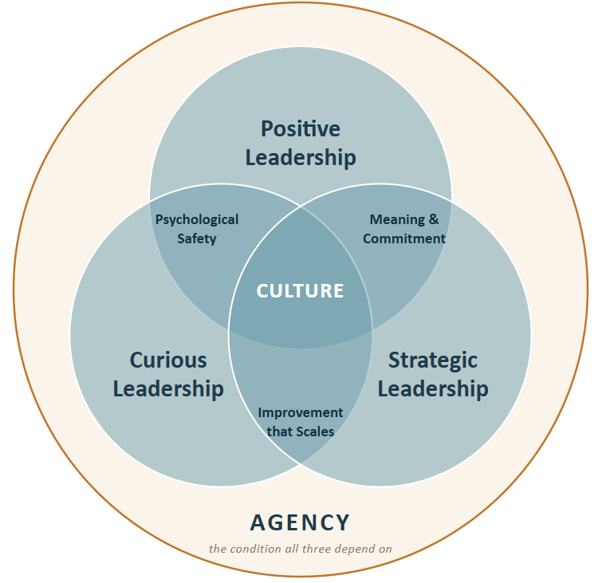
A single model applied to three different leadership problems
Which is why they combine well, and why you can start with one.
Positive Leadership
For organisations where people are tired, turnover is rising, or sustained pressure has flattened the energy out of teams. You get: retention, lower sickness absence, reduced agency spend, and engagement that holds under pressure rather than collapsing at the first difficult quarter.
Curious Leadership
For organisations that must improve services with fewer resources, and teams where people have quietly stopped saying what they think. You get: improvement generated from inside rather than commissioned from outside, problems surfaced early rather than hidden, and a workforce that adapts rather than waits.
Strategic Leadership
For leadership teams whose strategy isn’t landing, and organisations needing strategic thinking further down than the top three people. You get: alignment, decisions made at the right level and at speed, less duplication and rework, and a strategy that survives contact with the organisation.
Underpinning all three: Agency
Whether people believe that acting will change anything. Without it, the other three cannot hold — which is why every programme builds it first, and why the diagnostic is called what it is.
Change and transition support
When roles are removed, two groups need attention. Usually only one gets it.
The people leaving are offered outplacement — often generic, often too early to be useful. The people who stay, who watched it happen, absorbed the extra work and drew their own conclusions about how the organisation treats people, are offered nothing at all.
For the people remaining: Survivor effect is real, under-addressed and expensive: reduced trust, lowered discretionary effort, and a spike in voluntary turnover six to twelve months later among exactly the people you most wanted to keep.
Very few providers do both halves. Doing only the first is a duty of care exercise. Doing both is a retention strategy.
Measurement
Most leadership development asks you to take its effects on trust. This one doesn’t.
Cohort and embedded programmes measure at intake and at close, against published instruments used in research — not scales invented for a brochure.
You receive an anonymised pre and post report for the group, with commentary on what moved, what didn’t, and what I’d recommend next. It is written to be shared with a board or a people committee.
| What is measured | Instrument |
| Energy and vitality | Subjective Vitality Scale |
| Quality of motivation | Self-determination self-regulation scales |
| Confidence and self-efficacy | Occupational Self-Efficacy Scale |
| Connectedness | Social Connectedness Scale |
| Clarity of identity and role | Self-Concept Clarity Scale |
| Sense of direction and purpose | Meaning in Life Questionnaire |
That matters here, because most leadership development is written by people who have only ever seen the intention, never the consequence. What I teach starts from what the job is actually like, rather than what the literature says it should be — while still being built on the literature.
My Credentials
| Field | Credentials |
| PRACTICE | Leading and developing teams in local government, education, a health charity and the NHS, to Head of Service and Director level. Chief Executive of two complex, multi-faceted charitable operations |
| ACADEMIC | MBA · Lecturer in Leadership, BPP University — teaching senior leaders across England and Wales |
| QUALIFIED | Coach training accredited by the International Coaching Federation (ICF Level 1) |
| PUBLISHED | Author of two books, on returning to work and on burnout |
| RECOGNISED | Executive Contributor, Brainz Magazine · Creo 2026 Award Winner |
| EVIDENCE | Work grounded in Bandura, Fredrickson, Edmondson, Luthans and self-determination theory as well as thought leaders in business strategy — and measured with validated instruments. |
| VOICE | Host of The Reframing Room — real stories of career transition and reinvention |
Thirty minutes, no charge. Tell me what you’re seeing and I’ll tell you honestly whether this is the right intervention — and what I’d suggest if it isn’t.
2. The Agency Audit
A confidential survey, four to six interviews, and a written report telling you where decisions have got stuck. Note that half the audit fee is credited against any programme of £7,500 or more, booked within three months.
3. The Brochure
Everything in full — the three programmes, the Agency audit, the Change and Transition training, the formats, the measurement approach and the rate card.
Practical matters: Professional indemnity insurance held. Survey and interview data handled under UK GDPR and reported only in anonymised form. Delivery in person across the East of England and London, or online. Most programmes are designed to sit below the direct-award thresholds under the Procurement Act 2023.
Four questions to ask your people if unsure
Not in a survey. Surveys are how organisations avoid asking. Ask them out loud, to a person, and then be quiet long enough to hear the answer.
- Can they act? When one of your people decides something, does it happen — or does it go somewhere to be considered?
- Are they getting better at something? Is there anywhere here a capable adult can try something difficult, get it wrong, and not pay for it? That is the only place competence is ever built.
- Do they matter to anyone? Last time you reorganised, you counted the roles, the reporting lines and the cost. Did anyone count the relationships?
- Does the story make sense? Can the person three levels down tell you what this organisation is for, and where they are in it, in their own words, without the slide?
If the answers are good, you have something most organisations don't and it is worth protecting. If they worry you, you have found the actual problem — which is considerably more useful than another engagement or satisfaction score.